💡 Key Takeaways
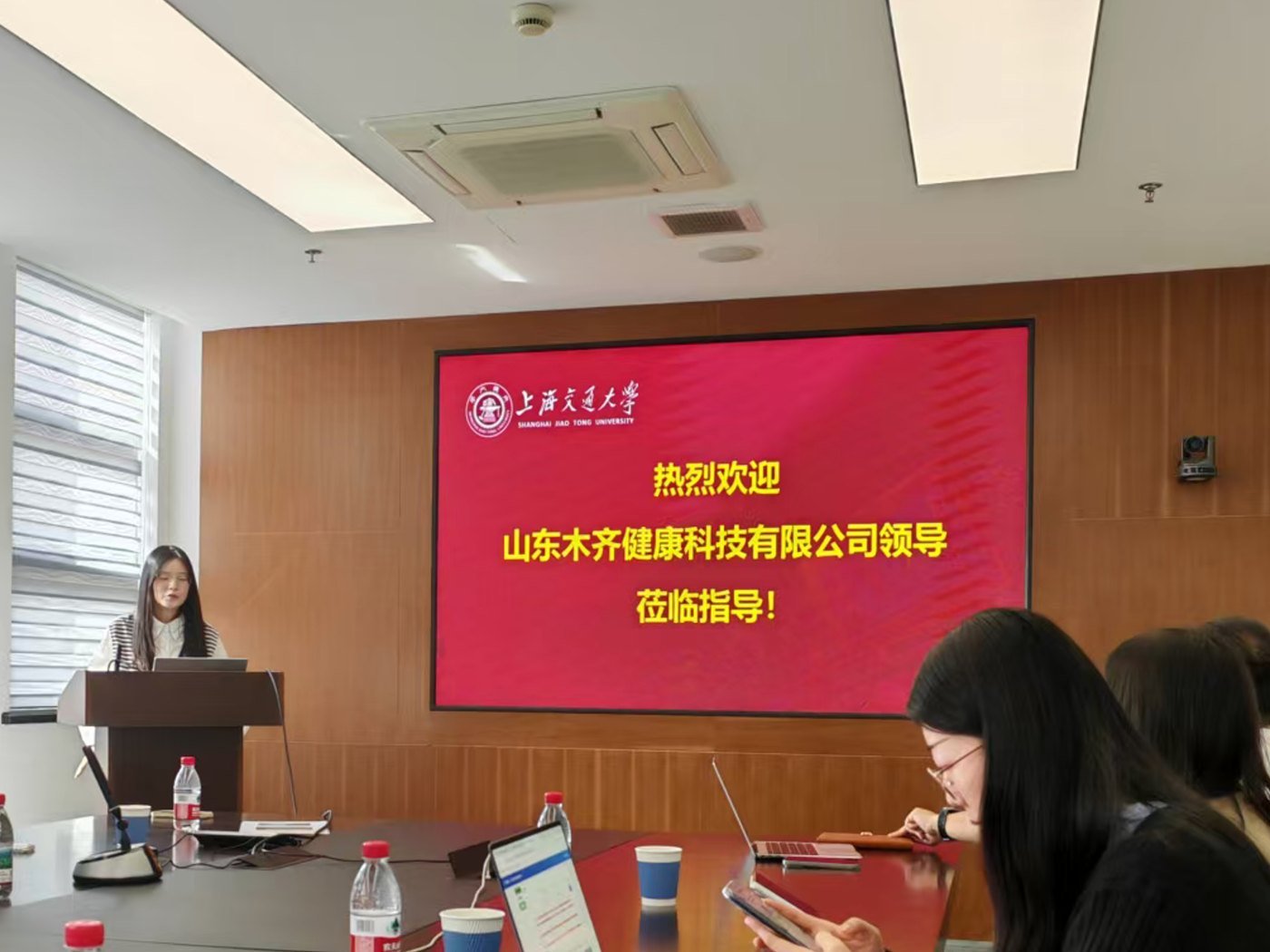
Hydrogen agriculture is not a new track — it is a spillover of hydrogen medicine and biology. More than 1,500 papers worldwide, roughly 90% from China, yet still zero independent statistical calibers: the bottleneck is delivery, not evidence. The globe is splitting into three routes — devices, materials, energy — and scenario decides the route; China's opportunity sits in solid materials. On 29 October 2026, Martin Chen (CEO, MUQI Tech) and Professor Pei Zhou's team at the SJTU Hydrogen Science Center spent an afternoon at Agri-Innovation Building B501 and agreed on three things: route alignment, evidence boundaries, and next-step field validation. Data as of October 2026.
1. Is Hydrogen Agriculture a New Track? It Is a Spillover
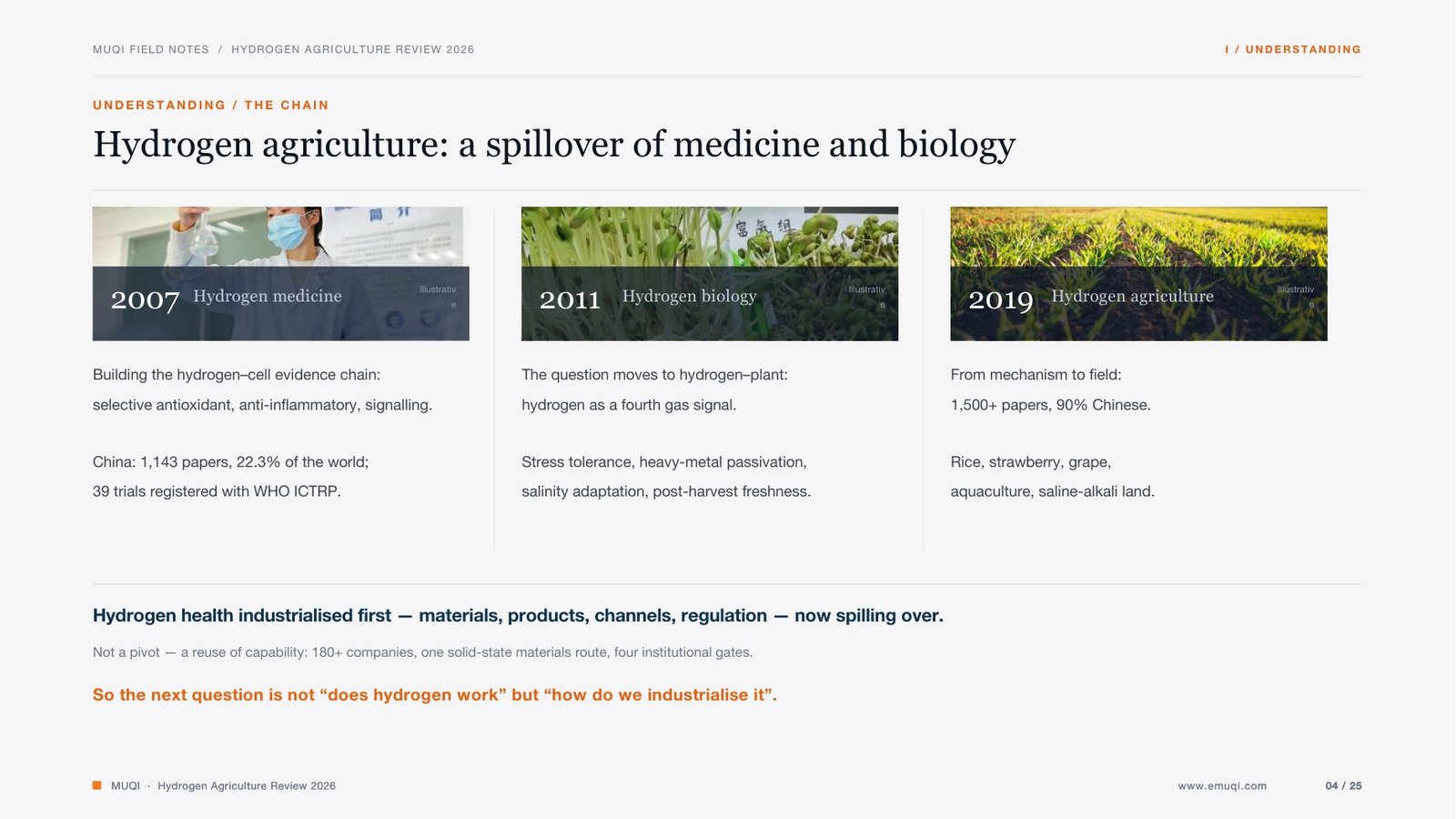
Not a new industry. According to Science & Technology Review 2024, No. 15, and the review by Wang YQ et al. (J Zhejiang Univ Sci B, 2020): around 2007 the “hydrogen–cell” evidence chain was established (selective antioxidation, anti-inflammation, signal regulation), with China contributing 1,143 papers — 22.3% of the global total — and 39 WHO ICTRP-registered trials. In 2011 hydrogen was recognised as the fourth gas-signalling molecule, and the question moved to “hydrogen–plants” (stress tolerance, heavy-metal immobilisation, saline-alkali adaptation, post-harvest preservation). From 2019 the work moved from mechanism toward the field: 1,500+ papers to date, about 90% from China.
The hydrogen wellness industry walked this path first: industrialisation capability in materials, products, channels and regulation is now spilling over into agriculture — 180+ companies, a solid-material route, four institutional gates. So this is not cross-industry adventurism; it is capability reuse. The next question is no longer “does hydrogen work?” but “how do we industrialise it?”
2. Why Can't 1,500 Papers Produce One Reproducible Case?
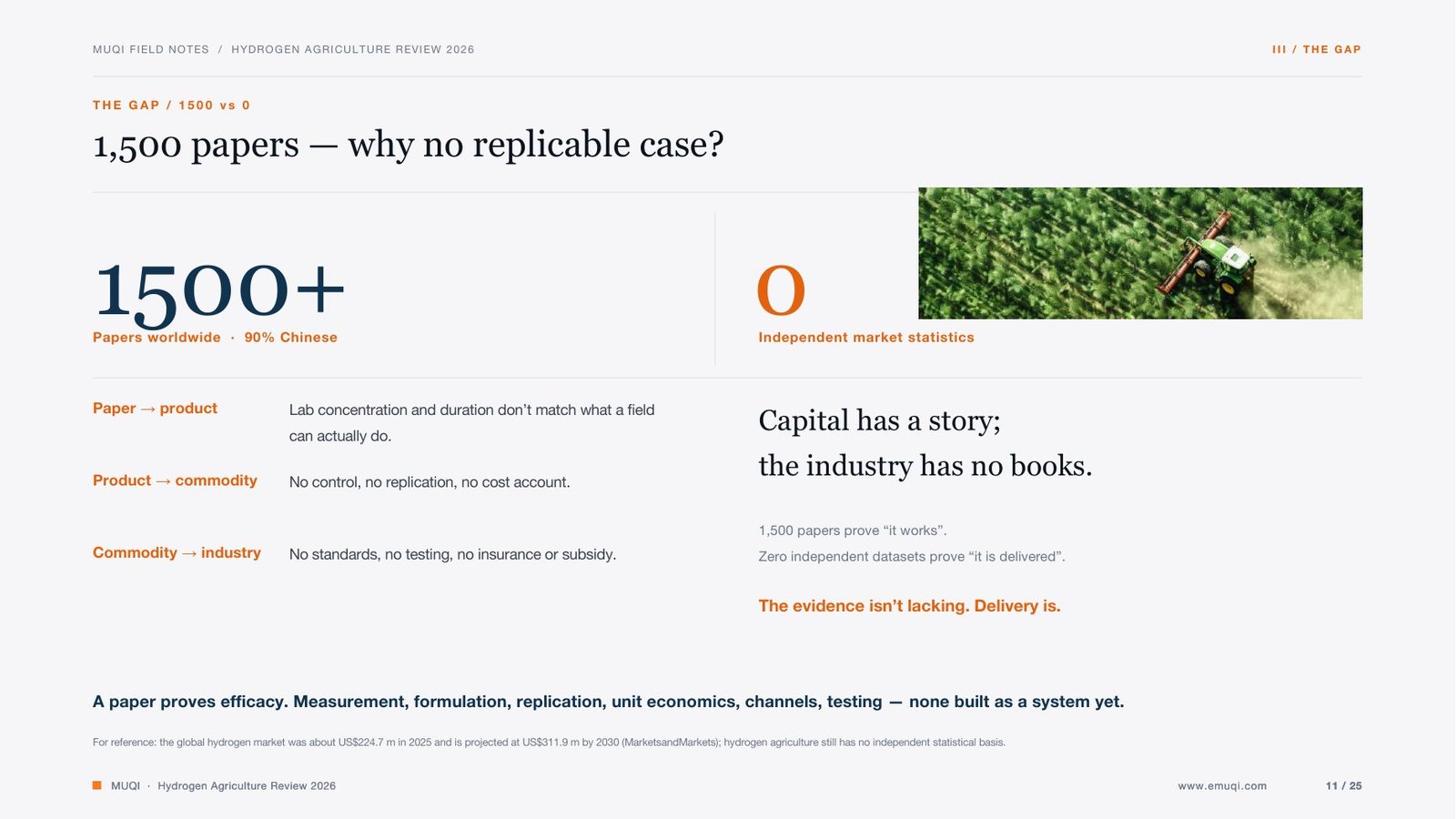
Because the bottleneck is delivery, not evidence. Papers answer whether something works; industry needs reproducibility. Many stories circulating in the industry are not wrong in conclusion — they err by presenting “demonstrations” as “industry”. The hard accounting: 1,500+ papers prove hydrogen affects plants, but each of the three conversion stages loses something —
- Paper → product: laboratory concentrations and durations do not map to operable field parameters;
- Product → commodity: no controls, no replication, no cost ledger;
- Commodity → industry: no standards, no testing, no insurance or subsidies.
Papers prove “effective”. Zero independent statistical calibers means “not delivered”. What the industry lacks most is a common ruler — what to measure, how, and at what dosage. Without it, a yield number from field A does not transfer to field B.
3. Three Global Routes — Scenario Decides the Route
Globally the field is splitting into three routes: devices, materials, and energy. The answer is not “which route is best” — scenario decides the route: three industries, three customers, three business models, and no single pitch covers them all.
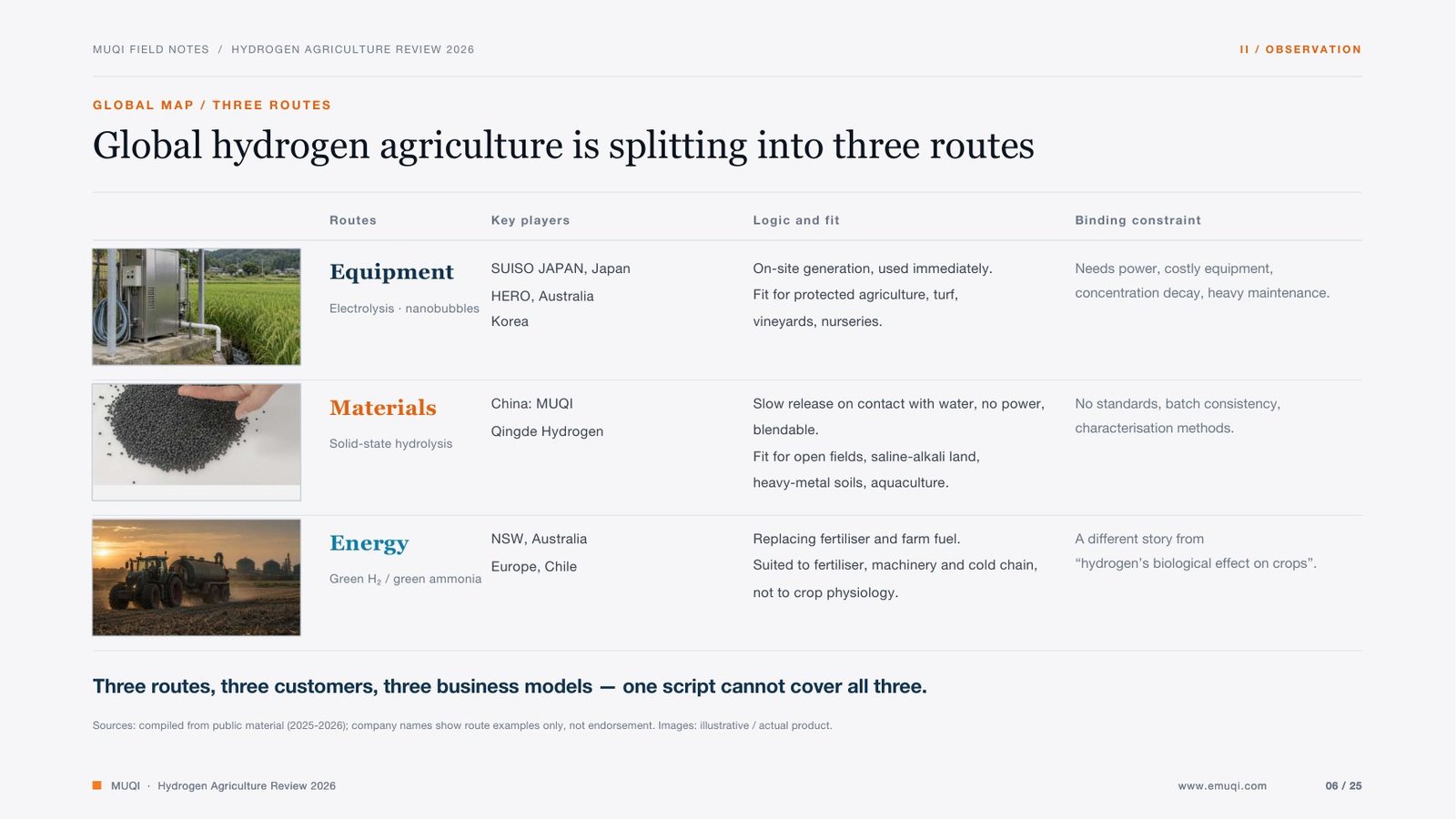
The device route: Japan sells hydrogen water as “equipment + brand agriculture”. In summer 2025 SUISO JAPAN launched “Suilive SA-1”, Japan's first agricultural hydrogen-dissolving unit, in Kamimachi-machi, Fukuoka (per SUISO JAPAN and Nihon Trim public information, 2025-09), growing rice with electrolysed hydrogen water and branding “hydrogen rice/melon”. Japan sells story, not parameters and standards — at the cost of power demand, expensive hardware, concentration decay and heavy maintenance.
Australia is the most instructive — one country, two entirely different “hydrogen agricultures”. On one side the device route: per HERO Irrigation / YBG Global product pages (accessed 2025-10), a single unit lists at US$16,311, PEM/SPE electrolysis with nanobubbles, explicitly promising no yield gains and requiring blank controls. On the other, energy hydrogen: per the NSW Government announcement (2025-03), A$45.2 million for an end-to-end hydrogen hub replacing imported fossil-based fertiliser and farm fuel. The latter is hydrogen-energy decarbonisation, not hydrogen-water agronomy — the two are constantly conflated, and Australia's lesson is precisely that.
Korea is convening; Europe and the US are decarbonising. Korea's policy-driven Hydrogen Agriculture Technology Association (h2zeta.or.kr) pushes “hydrogen agriculture + smart greenhouses”, with few public trial data and strong demonstration character; Europe and the US bring hydrogen into agri-food systems via fertiliser, machinery and cold chain. China is different: 90% of the papers run on a unique material route — skipping “devices first” and taking materials straight to the open field. There is no best technology, only scenario fit.
4. Profit Sits at Both Ends: The Smile Curve and MUQI's Choice
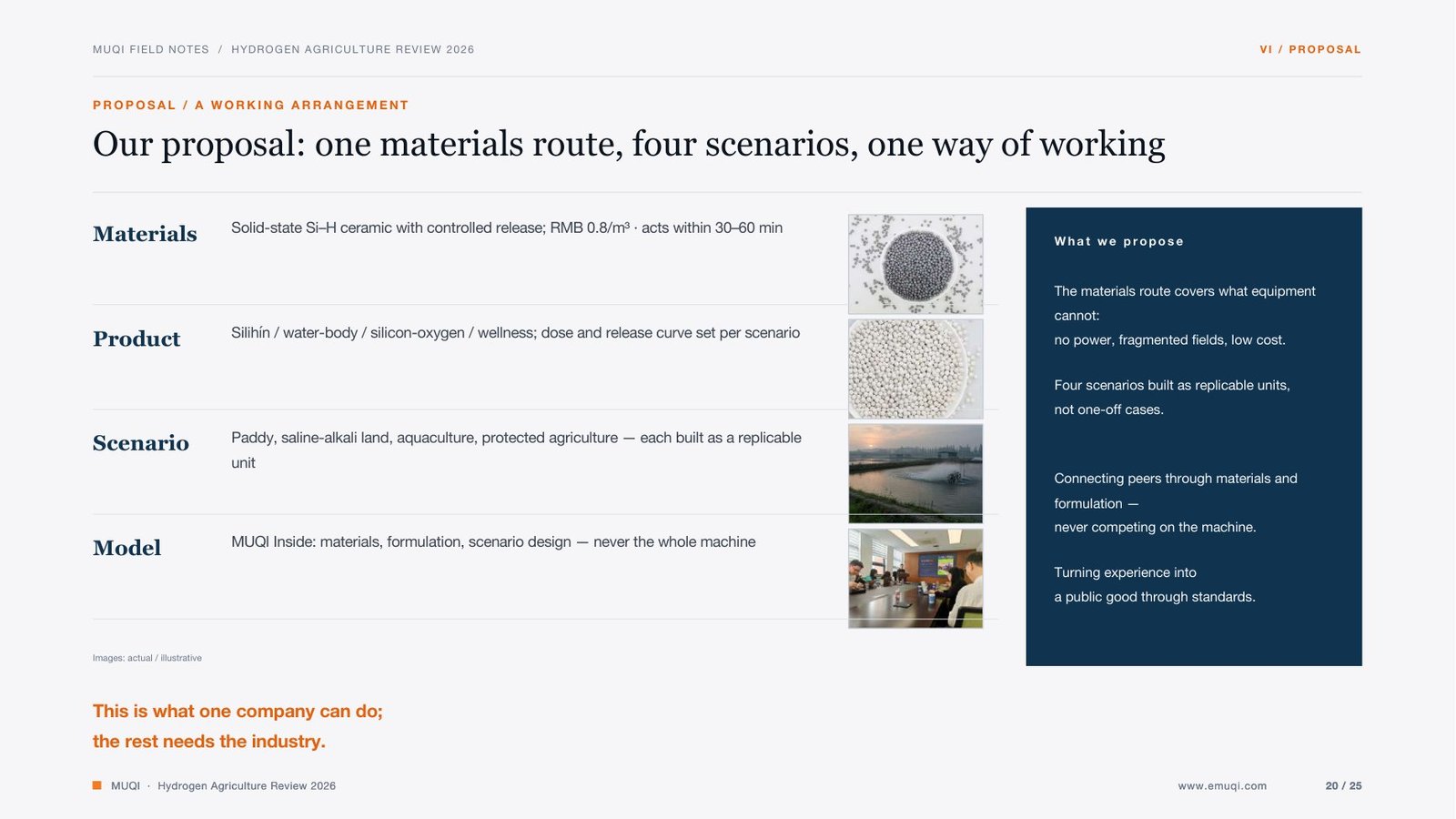
Between paper and field stand six things that must be built separately: metrology and standards, product formulation, field reproducibility, cost ledgers, channels and service, testing and insurance. Until they exist, papers remain demonstrations. The deeper logic across the three routes: profit is not in device assembly but at the materials and scenario ends — devices mean thin margins, price wars, one-off sales; materials/formulation means high margin, replicability, repurchase; scenario/brand means high premium, slow but deeply moated.
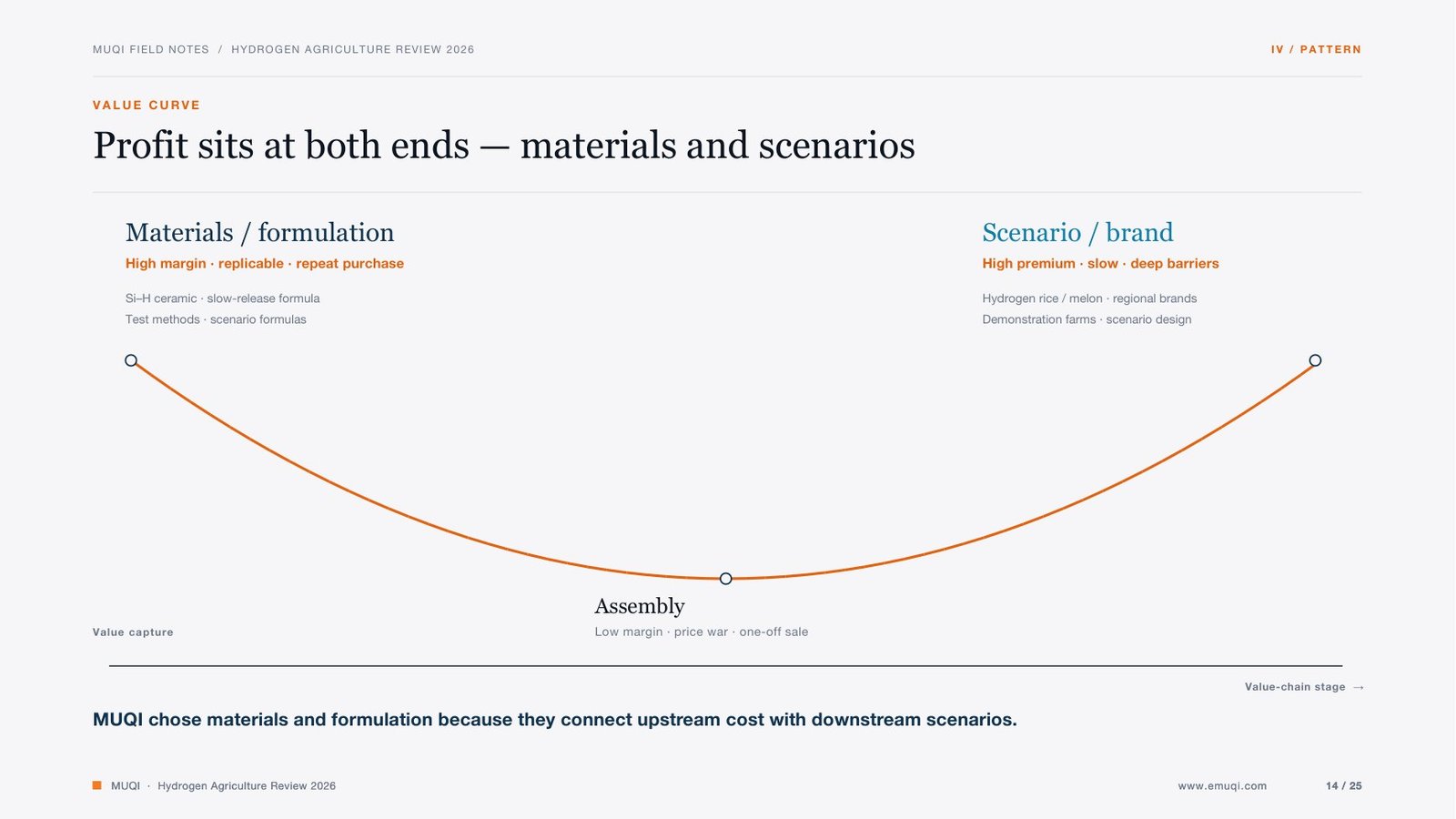
That is why MUQI's choice is explicit: no complete machines — materials and formulations, turning hydrogen from a hazardous gas into a transportable, blendable, repurchasable solid material. The MUQI laboratory was co-built with the Technical Institute of Physics and Chemistry, CAS; founded in 2014 with 12 years of industrialisation, 37 patents (15 invention patents), an 800 m² laboratory and four product lines (soil / aquaculture / drinking water / health). One solid-state hydrogen-release platform serves both wellness and agriculture.
* Company demonstration data (2025 compilation, unpublished); not a strict controlled trial and no yield promise is made.
5. What Was Actually Agreed in Shanghai? Three Consensus Items
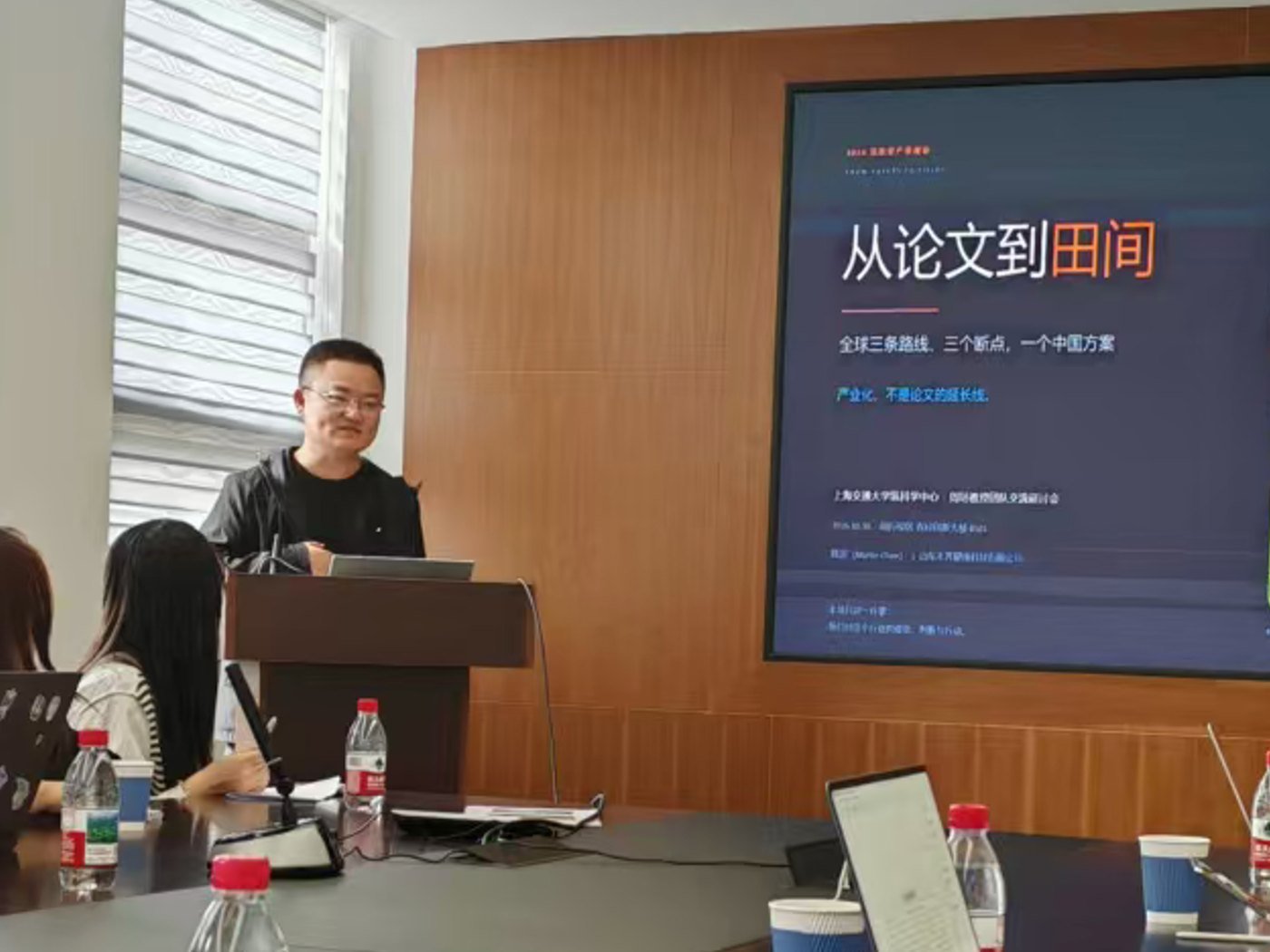
On 29 October 2026, in Agri-Innovation Building B501, Professor Pei Zhou's team and MUQI exchanged views point by point on six questions about the silicon-hydrogen granules. Conclusions belong to field data; the three things agreed that day are:
- Route alignment — how the three global routes differ from the Chinese approach;
- Evidence boundaries — papers, demonstrations and controlled trials stated separately;
- Next steps — a field-validation plan, samples and a joint research topic.
6. Which Six Questions Did the SJTU Team Ask?
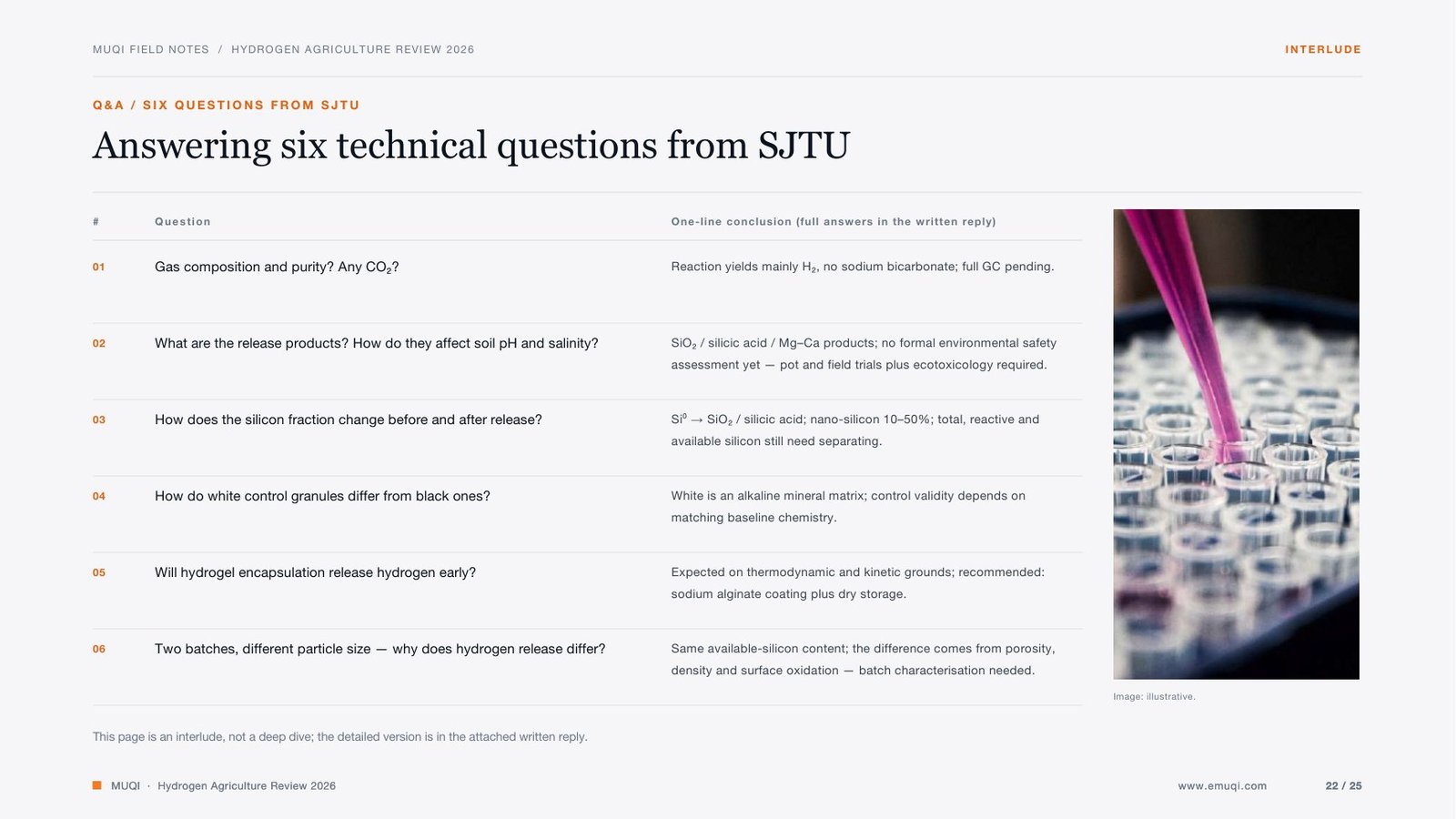
All six questions target delivery: gas composition, release products, silicon fraction changes, control granules, premature release from encapsulation, and batch particle-size differences. This is not interrogation — it is the standard due-diligence an academic team applies before anything enters the field. Point-by-point replies below (the detailed written reply is attached separately).
| Question | One-line conclusion | Note |
|---|---|---|
| 01 Gas composition and purity? Any CO₂? | Reaction yields mainly H₂, no sodium bicarbonate; full GC analysis pending | — |
| 02 What are the release products? Effects on soil pH/salinity? | SiO₂ / silicic acid / Mg–Ca products; no formal environmental safety assessment yet | Pot/field trials + ecotoxicology required |
| 03 How does the silicon fraction change before and after release? | Si⁰ → SiO₂ / silicic acid; nano-silicon 10–50% | Total/reactive/available silicon still to be separated |
| 04 How do white control granules differ from black ones? | White is an alkaline mineral matrix; control validity depends on matching baseline chemistry | — |
| 05 Will hydrogel encapsulation release hydrogen early? | Expected on thermodynamic and kinetic grounds | Sodium-alginate coating + dry storage recommended |
| 06 Two batches, different particle size — why does release differ? | Available-silicon content matches; difference comes from porosity, density, surface oxidation | Batch characterisation needed |
7. What Comes Next: Four Gates and Six Big Pieces
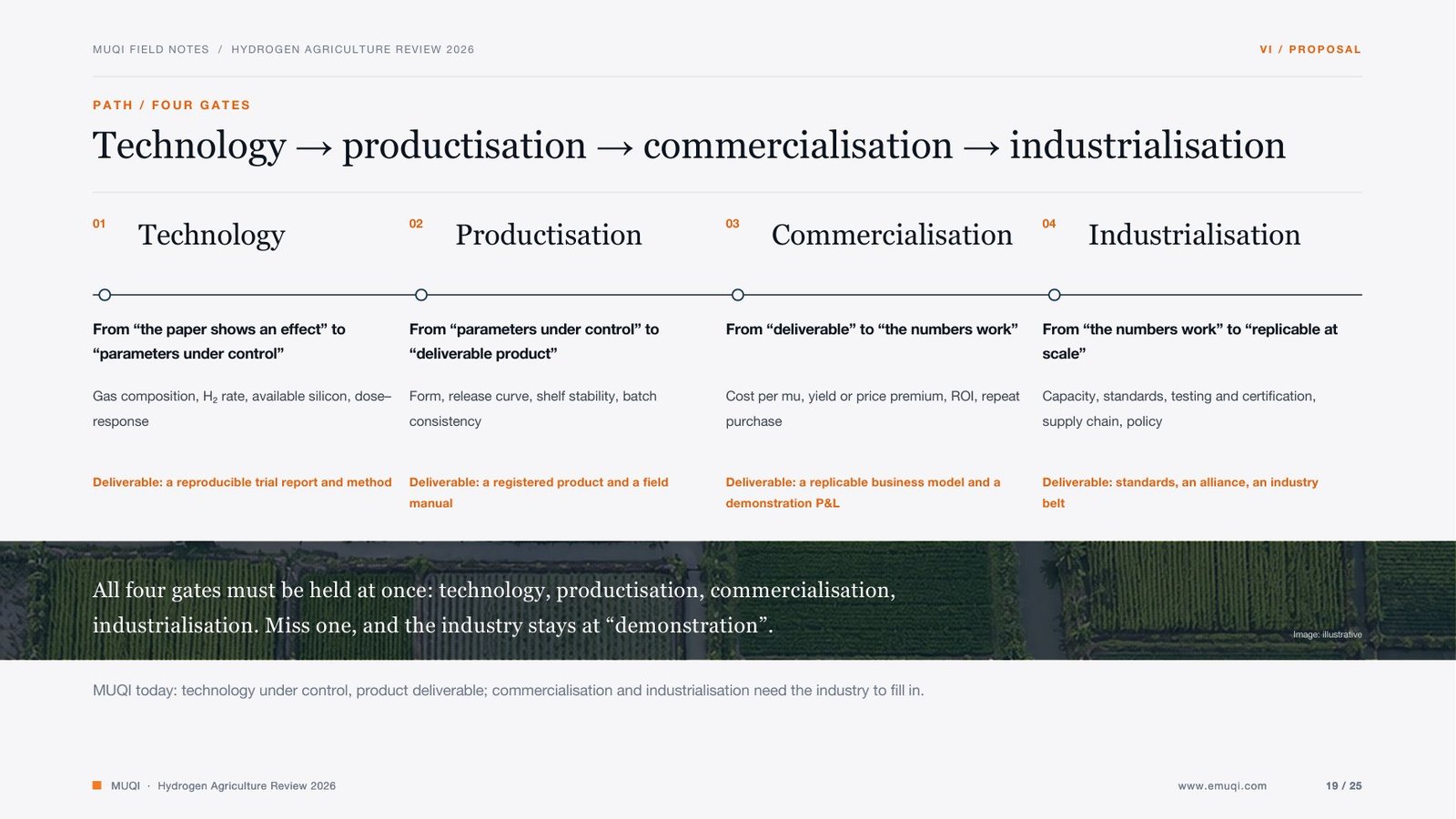
When does hydrogen agriculture actually land? Only after four gates: technology → productisation → commercialisation → industrialisation. Today most of the industry is stuck between the first and second. Before landing, six “big pieces” remain:
- Metrology and standards — what to measure and at what dosage;
- Product formulation — how farmers actually apply it;
- Field reproducibility — how to control and replicate;
- Cost ledger — cost per mu, repurchase viability;
- Channels and service — who sells, who trains, who repairs;
- Testing and insurance — who certifies, who underwrites.
📎 Sources and Notes
• Papers and mechanism reviews: Science & Technology Review 2024, Vol. 42 No. 15, “Green hydrogen agronomy” feature; Wang YQ et al.,
Hydrogen agronomy: research progress and prospects, J Zhejiang Univ Sci B, 2020.
• Industry and market data: 2026 China Hydrogen Health Industry Development Report (China chapter, 2026-10); National Bureau of
Statistics 2025 retail-above-quota figures; MarketandMarkets Hydrogen Market Report 2025–2030; QYResearch.
• Overseas routes: SUISO JAPAN and Nihon Trim public information (2025-09); HERO Irrigation / YBG Global product pages (accessed 2025-10);
NSW Government: Innovative green hydrogen and ammonia project (2025-03); Korea Hydrogen Agriculture Technology Association (h2zeta.or.kr).
• Scenario data: MUQI internal trial and demonstration records (2025 compilation, unpublished). Scenario data are company demonstration
figures, not strict controlled trials, and constitute no yield promise.
• All company names are cited as route examples only and imply no judgement. Sourcing principle: traceable · checkable · not equated.
Data as of October 2026.
* This article is industry commentary. It is not medical, agronomic or insurance advice; hydrogen agriculture products do not replace proper farming, fertiliser and pesticide management, or commercial insurance.
Frequently Asked Questions (FAQ)
What is hydrogen agriculture — and is it the same thing as hydrogen energy?
No. Hydrogen agriculture refers to hydrogen or hydrogen-bearing materials acting on crops and water, originating from the three-stage spillover of hydrogen medicine into hydrogen biology and then agriculture. Hydrogen energy (energy hydrogen) addresses decarbonisation of fertiliser, farm machinery fuel and cold chains. The two differ in customers, price points and validation methods, and confusing them is the industry's most common framing error.
Is there real scientific evidence behind hydrogen agriculture?
Yes — and plenty of it. More than 1,500 papers have been published worldwide, roughly 90% of them from China. Hydrogen has been listed as the fourth gas-signalling molecule since 2011, with mechanistic work on stress tolerance, heavy-metal immobilisation, saline-alkali adaptation and post-harvest preservation (see Science & Technology Review 2024, No. 15, and Wang et al. 2020).
If there are so many papers, why no large-scale adoption yet?
Because papers prove an effect, not a deliverable. Between paper and industry sit six things that must be built separately: metrology and standards, product formulation, field reproducibility, cost ledgers, channels and service, and testing plus insurance. The industry still lacks a unified measurement caliber — and any reproducible, independently accounted case.
How do I choose between the device route and the material route?
Choose by scenario, not by technology. Powered, piped, high-value protected agriculture and turf can justify electrolysis devices; unpowered, dispersed, low-cost saline-alkali fields and open farmland call for solid materials. Fertiliser substitution and machinery fuel belong to the energy route, which decarbonises inputs rather than agronomy. There is no best technology — only scenario fit.
Are solid-state hydrogen materials safe for agricultural use?
The silicon-hydrogen materials discussed here react mainly to release hydrogen, yielding SiO₂ / silicic acid and Mg–Ca products. No formal environmental safety assessment exists yet: pot and field trials plus ecotoxicology are required. MUQI has listed this as a priority topic for joint validation with SJTU; safety conclusions await completed testing, and this article makes no claims.